
Arraigo
Currently in its discovery phase.
A field research project on how AI lands on the people it's used on: the workers, applicants, and patients on the receiving end of someone else's deployment. Everyone audits the algorithm; almost nobody listens to the people it's used on. Arraigo starts from that gap, structured interviews with the people an AI system actually touches, about their fears, misconceptions, harms, and conditions of acceptance, gathered under consent that stays with the person who spoke.
The root of inspiration is Article 27 of the EU AI Act: before deploying high-risk AI, certain organizations must assess the impact on people's fundamental rights, name who will be affected, and what could go wrong for them. The law points at those people. Arraigo goes and listens to them.
It's early. If you'd like to hear more about the project, or your own workplace is introducing AI and you have something to say about it, write me in the contact form.
Vinculo
Personal Project
An invite-only map of how people are already connected: through the projects and organizations they've shared, never through each other directly. I'm designing and building it end to end, the data model and consent layer, the force-directed graph, and the one hand-made moment where a connection traces its own path across the network and narrates how it came to exist.
It's still early, with a lot left to build. I work in the open, so you can follow the process commit by commit:
Launched the initial phase of a programming language
-
Academic driven curiosity about how abstraction actually works in programming. What happens between writing code and it executing? How do languages interpret human instructions into machine operations?
Built the foundational elements from scratch using TypeScript and Deno: a lexer to tokenize input, an abstract syntax tree to represent code structure, and a parser to bridge between the two. Then built an interpreter to actually execute the AST, solving basic numerical operations and running as a REPL.
-
Building a language from scratch, even basically, meant seeing patterns we take for granted. Every operator, every syntax rule, every way we structure code is someone's design decision about how to abstract complexity.
The technical curiosity was the entry point. What stayed was recognizing programming is fundamentally about designing abstractions.
SOLERA
My first startup story: 2024
The problem was clear: traders were juggling multiple platforms, one for analytics, another for transactions, a third for portfolio tracking. Every context switch costs time. Solera was built to unify all into one mobile experience.
We were two: a backend developer and myself on frontend, working in React Native. The technical challenge was making real-time trading feel seamless, live price updates, instant transaction execution, portfolio management that didn't lag.
What it took: building in production while the market shifted weekly, pitching to investors while metrics were still uncertain, applying to YC, learning when persistence matters and when it's time to shut down.
The demo was the first step, proof of concept. Somewhere in that process, we got the reality check we needed. Knowing when to let it go is as important as knowing when to push forward. We analyzed and arrived to a realization, done moved on to the next project.
Applied to YC 2024
Got first round investment by an angel
Talked around with community in Berlin
Got a reality check and concluded the project
Stealth
The second Startup Story 2025
This was the high-stakes project. Working in the web3 space where the idea was clear, execution was everything. Perfection, speed.
I worked as frontend developer in a four-person team: senior developers, backend engineers who'd built at scale. Non-stop working environment.
What I learned: how to communicate when every hour counts, how to make feature decisions quickly without breaking things, how to ship fast without compromising quality. My knowledge grew beyond frontend, understanding how backend architecture affects performance, how design choices impact implementation speed, how the whole system moves together.
Where Tech & Art fused
I always saw the intersection of technology and art as fascinating - where today's innovations could actually conjoin. For a long time it stayed theoretical, an idea about what could be possible.
In 2023, right before moving to Berlin, I decided to test it. I wanted to create immersive spaces where technology opened up new possibilities for artists - a space where their ideas weren't constrained by physical limitations. That's where the Sphere project started.
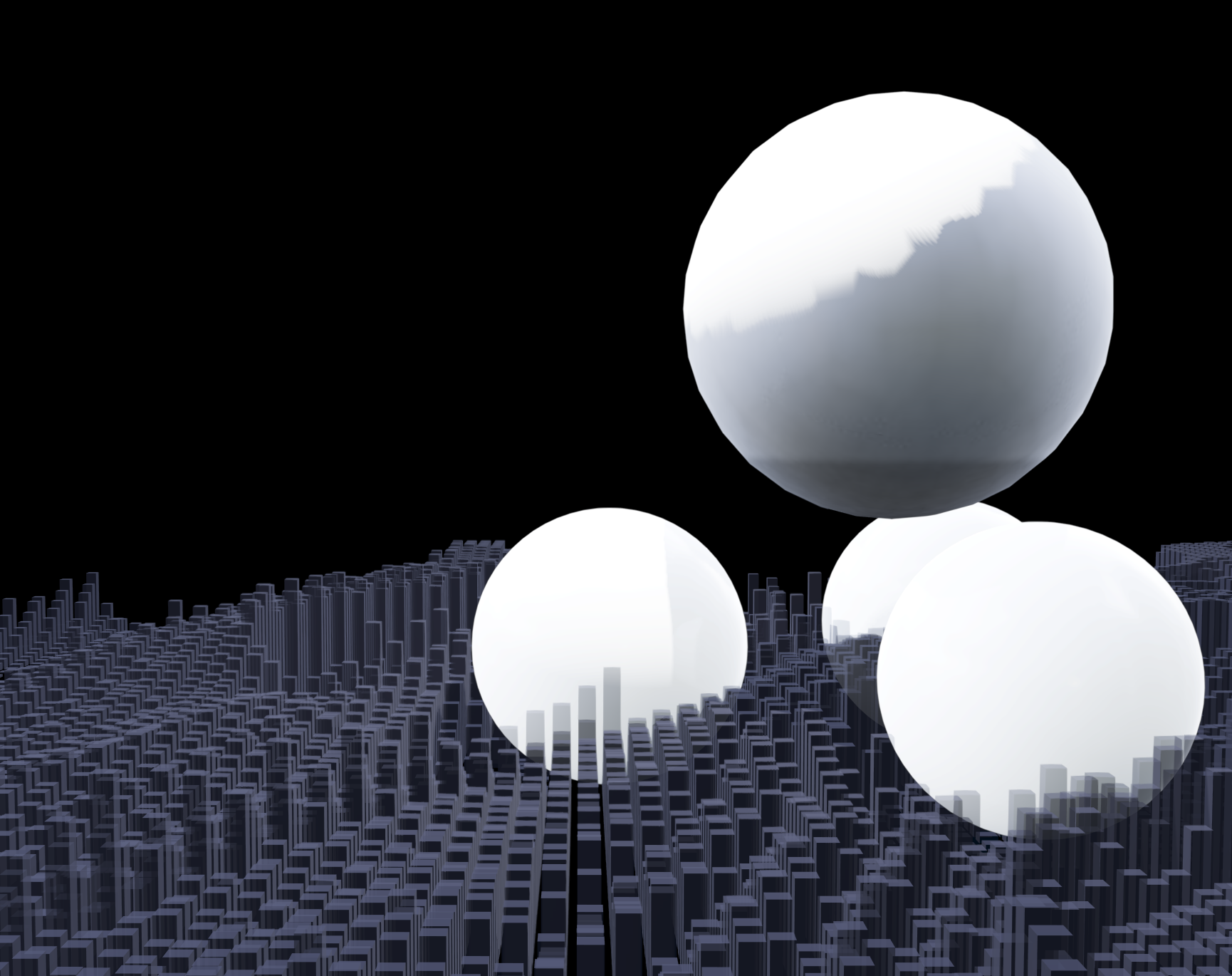
I worked with two artists to build interactive 3D installations. Maria, a glass artist, whose work explores fragility and materiality, the "Who Said Fragile?" installation translated her physical glass pieces into a digital space where visitors could interact with them in ways impossible with actual glass. The second was an experimental music duo from Uruguay. We explored the interconnectivity of networked grids to visualize their music flow, translating sound into spatial geometry.
The technical challenge was building these environments in Vectary and creating intuitive interactions. How do you make a 3D space feel navigable without instructions? The design challenge was translating each artist's vision into something that felt true to their work while taking advantage of what digital space could offer.
What I learned: giving artists technical freedom means understanding their work deeply enough to propose what's actually possible, not just what sounds cool. The sphere became the framework - observation from all angles, no boundaries, but still coherent and contained.

Who Said Fragile? 2023. Maria.

Geometric sounds. 2023.
E-Commerce
E-Commerce, A handful of client sites, hand-built back when making a website still meant building it from scratch. Different businesses, different constraints, one throughline: learning what actually converts.